
The Government’s Islamophobia Response Misses the Mark

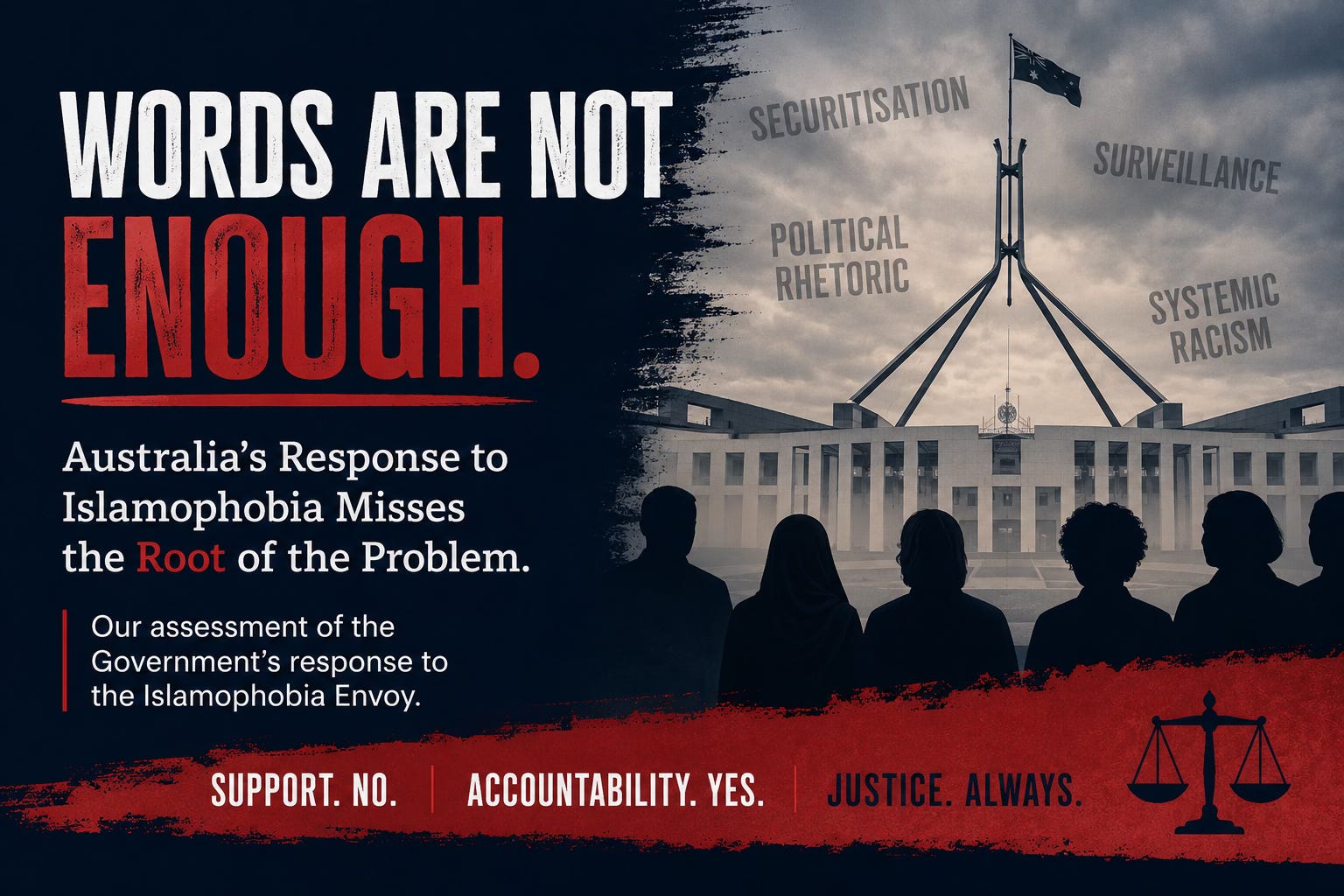
The Australian Government has released a response to the Islamophobia Envoy that is designed to look substantial. It is long. It lists dozens of initiatives. It draws together programs across education, mental health, policing, media, research, reporting and social cohesion.
But once the document is examined closely, a very different picture emerges.
Much of what is presented as the government’s response was already announced, already funded or already underway. Most of the genuinely new Islamophobia-specific initiatives have no disclosed budget.
The government has not said which of the envoy’s 54 recommendations it accepts. And the structures that have helped produce Islamophobia, including securitisation, policing, political rhetoric, institutional discrimination and the suppression of Palestinian advocacy, are left largely untouched. This is the central problem:
The government has produced a response that is far more focused on helping Muslim Australians endure Islamophobia than on dismantling what causes it.
Islamophobia is often reduced to individual prejudice, vilification or acts of hate. Those forms are real and harmful. But the most powerful forms of Islamophobia are structural. They operate through law, policy, policing, national-security frameworks, political rhetoric, media institutions and the regulation of Muslim participation in public life.
At its core, Islamophobia is about the denial of agency. It seeks to control how Muslims present themselves, what they may say, how they organise, which political positions are considered legitimate, and whether they may participate in public life on their own terms.
The envoy’s 54 recommendations gave the government an opportunity to begin to confront those deeper structures. It chose not to.
The response is much smaller than it appears
The government has combined new measures with existing programs, earlier announcements, routine government activity and proposals that remain under development or consideration.
Once those categories are separated, the scale of genuinely new action becomes much clearer.
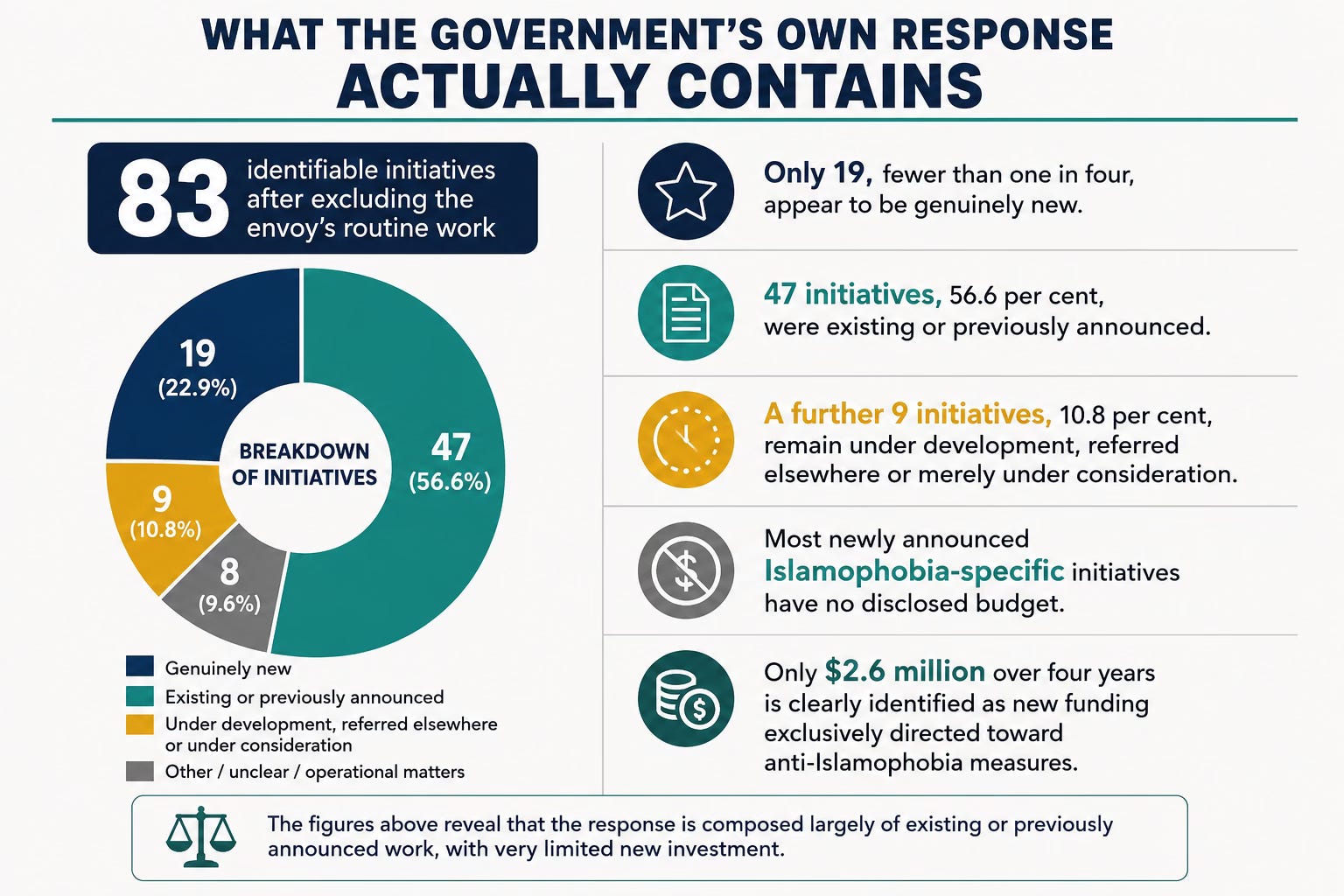
The figures matter.
Fewer than one in four of the identifiable initiatives appear to be genuinely new. More than half were existing or previously announced. Most of the new Islamophobia-specific initiatives have no disclosed budget, and
Only $2.6 million over four years is clearly identified as new funding exclusively directed toward anti-Islamophobia measures.
That stands in contrast to the scale of government mobilisation around antisemitism, including the $604.2 million Bondi response package across security, policing, education, mental health and related measures.
Not every dollar in that package was directed exclusively to antisemitism, but the disparity in political priority, financial commitment and institutional mobilisation is unmistakable.
The government has also failed to publish a recommendation-by-recommendation response. The public still does not know which of the envoy’s 54 recommendations have been accepted, deferred, rejected, reshaped or ignored.
The central drivers remain untouched
The response gives little serious attention to almost three decades of securitisation of Muslim Australians.
Successive governments have shaped law, policing, intelligence, public funding and political discourse through a counter-terrorism framework that has repeatedly treated Muslims as a community to be monitored, managed and controlled.
That process has been one of the most significant drivers of contemporary Islamophobia.
Yet the government proposes more police liaison and greater reporting without accepting independent scrutiny of policing, national-security laws or the discriminatory effects of counter-terrorism policy.
Community liaison is not accountability.
The response also largely avoids anti-Palestinian and anti-Arab racism, even though the suppression of Palestinian advocacy has become one of the clearest contemporary expressions of institutional Islamophobia.
Muslim, Palestinian and Arab Australians have faced restrictions on protest, attempts to control political language, pressure in workplaces and universities, and the repeated conflation of solidarity with extremism.
The government cannot credibly address Islamophobia while refusing to confront the treatment of Palestine advocacy.
Social cohesion cannot become a demand for Muslim compliance
The response repeatedly places Islamophobia within a social-cohesion framework.
In the current political climate, that language is not neutral. Social cohesion has increasingly been used to demand restraint, reassurance and compliance from Muslim communities, particularly in relation to Palestine, protest and criticism of government policy.
The government says Muslims should not bear responsibility for solving Islamophobia, yet much of its response asks Muslim communities to demonstrate resilience, participate in approved forms of engagement and contribute to social harmony.
Equal citizenship cannot depend on Muslims moderating their political voice or proving their value to others.
What a serious response would require
A serious national response must move beyond grants, training programs and advisory bodies.
It must confront the laws, policies and institutions that produce unequal treatment, silence political participation and deny Muslim agency.
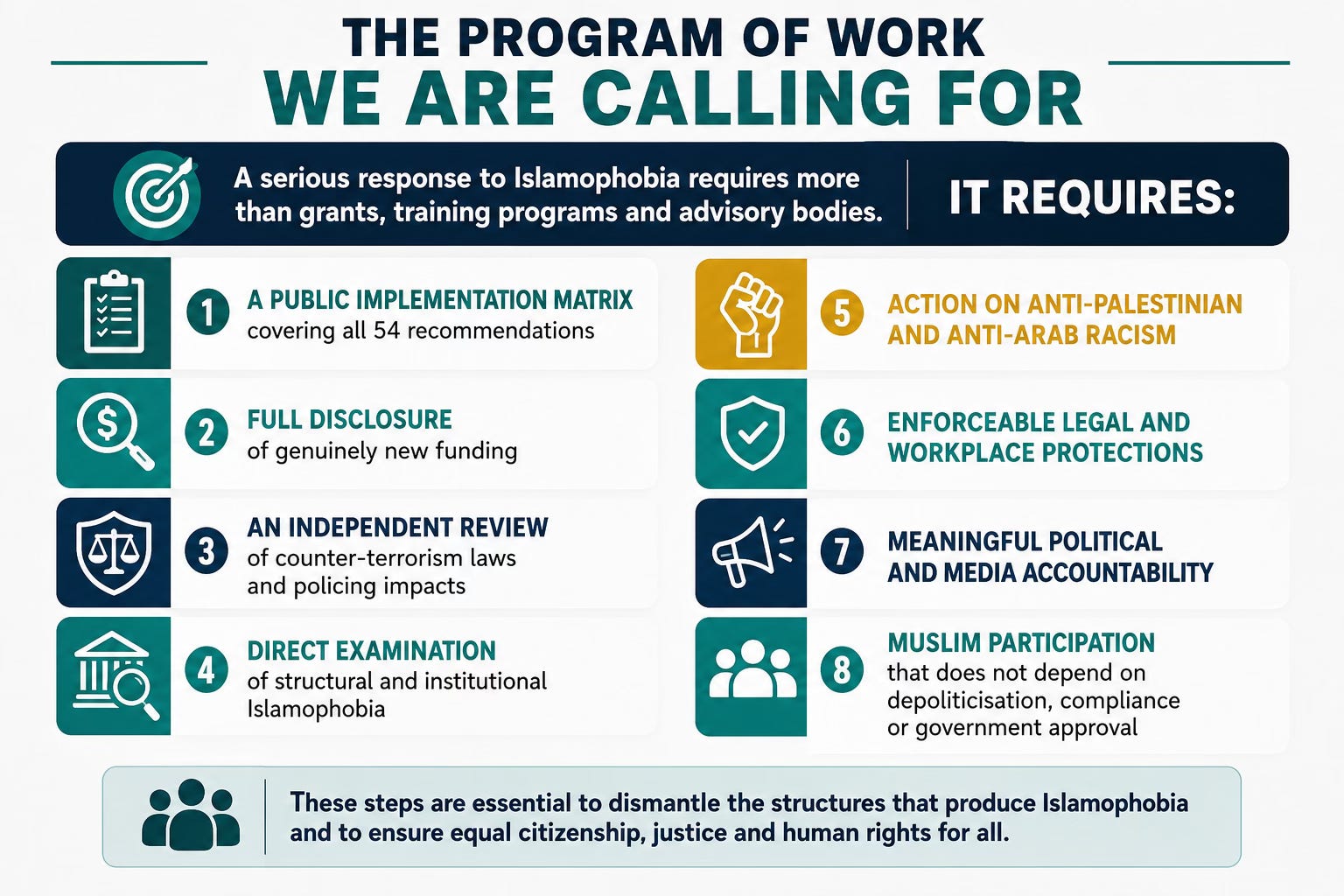
These are not optional additions to the government’s response. They are the minimum foundations of a credible program of structural reform.
Without them, the government is offering programs to manage the consequences of Islamophobia while leaving its most powerful drivers intact.
Why this assessment must be read
This issue is bigger than one report, one envoy or one package of government initiatives.
It is about the direction of political power in Australia.
It is about whether governments can use the language of social cohesion while expanding policing, regulation and control.
It is about whether Muslim political participation will be accepted on its own terms, or only when it is compliant, depoliticised and approved.
It is about whether anti-Palestinian racism, securitisation and institutional discrimination will continue to be excluded from the official account of Islamophobia.
And it is about whether a government can present existing programs and minimal new funding as a comprehensive response to decades of structural harm.
Every Muslim Australian should understand what is being proposed in their name.
Every person concerned with equality, justice, civil liberties, human rights and the future of democratic participation in this country should understand it as well.
This is not a technical policy disagreement but a struggle over who is permitted to speak, organise, dissent and participate in public life with full agency.
Download the full MVM assessment below. Understand what the government has included, what it has overstated and, most importantly, what it has chosen to leave untouched.
Download MVM's Full Assessment Here
Supporting Our Work

MVM remains entirely volunteer-led. We do not have corporate backers, institutional funding, or large donors underwriting this work. Everything we produce, from submissions and research to community briefings and election guidance, is made freely available because we believe civic literacy and principled engagement should not sit behind a paywall.
At the same time, sustained advocacy, research, and national coordination require resources. If you find value in what MVM is doing and the role it is playing in strengthening civic participation, we invite you to consider becoming a paid subscriber on Substack. A paid subscription is not about accessing content, it is about helping sustain independent, community-driven work.
Your support, at whatever level you are able, enables us to continue operating with clarity, independence, and accountability to the community alone.