
Permanent ASIO Questioning Powers, Permanent Risks to Democratic Freedom
An analysis of the Australian Security Intelligence Organisation Amendment Bill (No 2) 2025

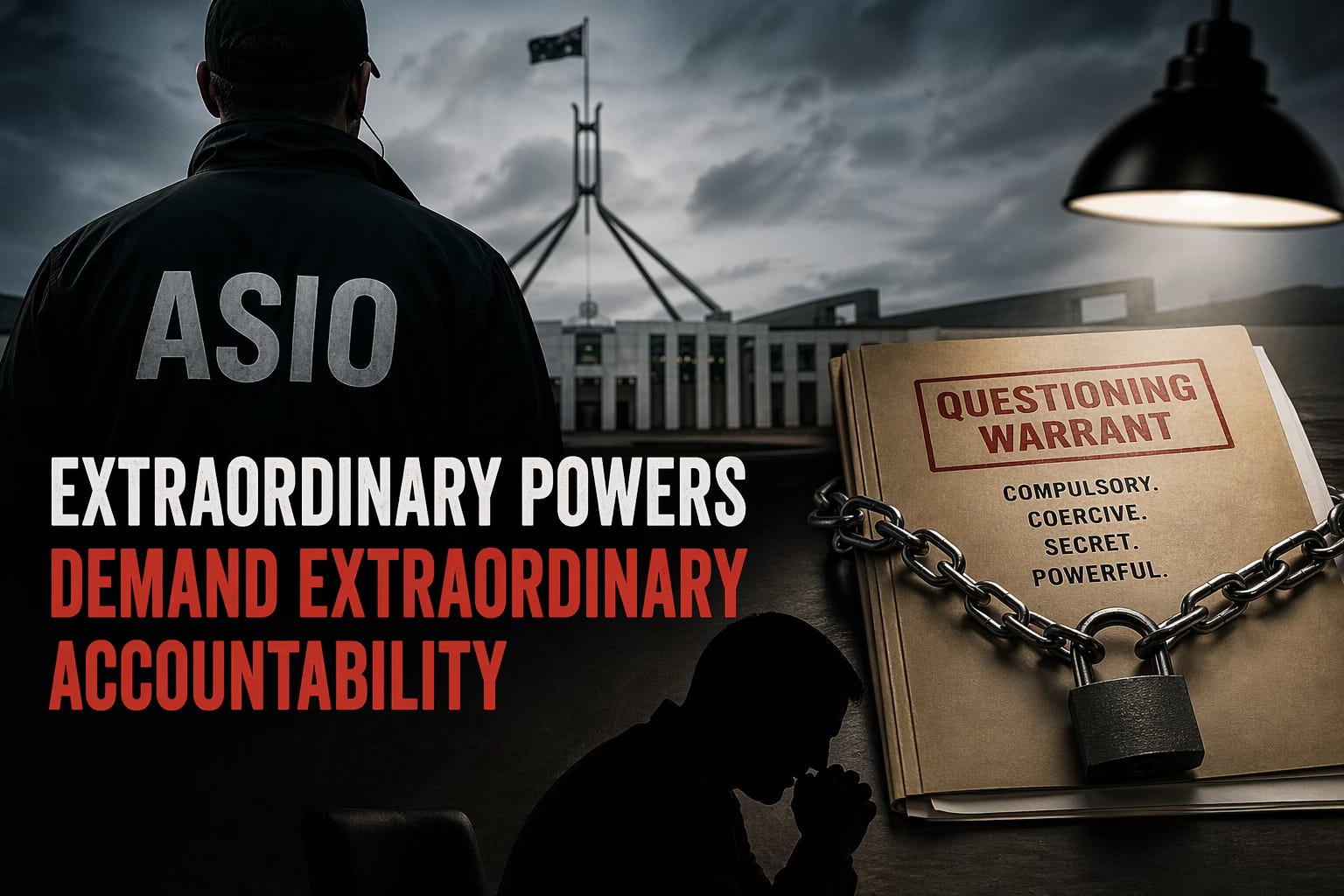
There is a difference between giving security agencies the powers they need and allowing extraordinary powers to become permanent features of the state. This bill crosses that line.
The Australian Security Intelligence Organisation Amendment Bill (No. 2) 2025 would make ASIO’s compulsory questioning powers permanent and expand the range of situations in which they can be used. It would also make a number of procedural changes to how the regime operates. But the real issue is whether powers that were introduced as exceptional, temporary and subject to repeated review should now be embedded more deeply into Australian law. 
Under the current framework, a person can be compelled to appear, answer questions and hand over material. Refusing to comply can lead to criminal penalties, including up to five years’ imprisonment. A person can be required to appear immediately, apprehended and searched to ensure compliance, questioned for extended periods, restricted from leaving Australia, and prevented from speaking openly about the warrant for years. The framework can also apply beyond the ordinary criminal process, including to non-suspect third parties, and it still allows the compulsory questioning of minors aged 14 to 17. 
That is why the proposal to make these powers permanent is of such concern. The bill does not simply keep the existing framework in place. It removes the sunset clause, broadens the definition of “adult questioning matter”, and leaves the minor questioning regime untouched. Legal and civil liberties bodies have raised serious concerns about that direction. The Law Council of Australia has said the sunset clause should remain, that the expansion into broader categories requires far stronger justification, and that the minor questioning regime should be repealed or at least allowed to sunset. It has also argued that the safeguards added by the bill do not resolve the deeper problems with the framework. 
Those concerns become sharper in the current political environment. This bill is being considered at a time when governments across Australia have been introducing, expanding or debating laws dealing with national security, extremism, hate, protest, public order and politically contested speech. In that setting, proposals to make exceptional coercive powers permanent, and to broaden their reach, should be approached with particular care. Powers of this kind do not operate in a vacuum. They operate in a real-world climate in which some communities are more likely than others to be viewed through the language of security, extremism, border risk or communal tension. 
The question for Parliament is not whether ASIO should have powers to protect the community. The real question is whether powers of this severity, backed by prison terms, apprehension and search, movement restrictions, secrecy obligations and reduced ordinary legal protections, should now be made permanent and expanded at all. On the material currently available, the case for doing so has not been convincingly made. 
Parliament should retain the sunset clause, reject or significantly narrow the proposed expansion into broader areas of security, repeal or sunset the minor questioning regime, and strengthen the safeguards before even considering permanence.
If this bill concerns you, raise it with your federal member of Parliament. Ask them why powers this extraordinary should now be made permanent, and urge them to oppose the bill unless these issues are properly addressed. 
You can read our detailed review of this legislation here:
Review of Australian Security Intelligence Organisation Amendment Bill (No 2) 2025
Supporting Our Work

MVM remains entirely volunteer-led. We do not have corporate backers, institutional funding, or large donors underwriting this work. Everything we produce, from submissions and research to community briefings and election guidance, is made freely available because we believe civic literacy and principled engagement should not sit behind a paywall.
At the same time, sustained advocacy, research, and national coordination require resources. If you find value in what MVM is doing and the role it is playing in strengthening civic participation, we invite you to consider becoming a paid subscriber on Substack. A paid subscription is not about accessing content, it is about helping sustain independent, community-driven work.
Your support, at whatever level you are able, enables us to continue operating with clarity, independence, and accountability to the community alone.